
Generative Artificial Intelligence (AI) models have revolutionized the field of image synthesis, enabling computers to generate realistic and high-quality images. These models have applications in various domains, including art, design, entertainment, and even scientific research. If you’re interested in building your own generative AI models for image synthesis, here are some essential points to guide you through the process:
1. Understand the Basics:
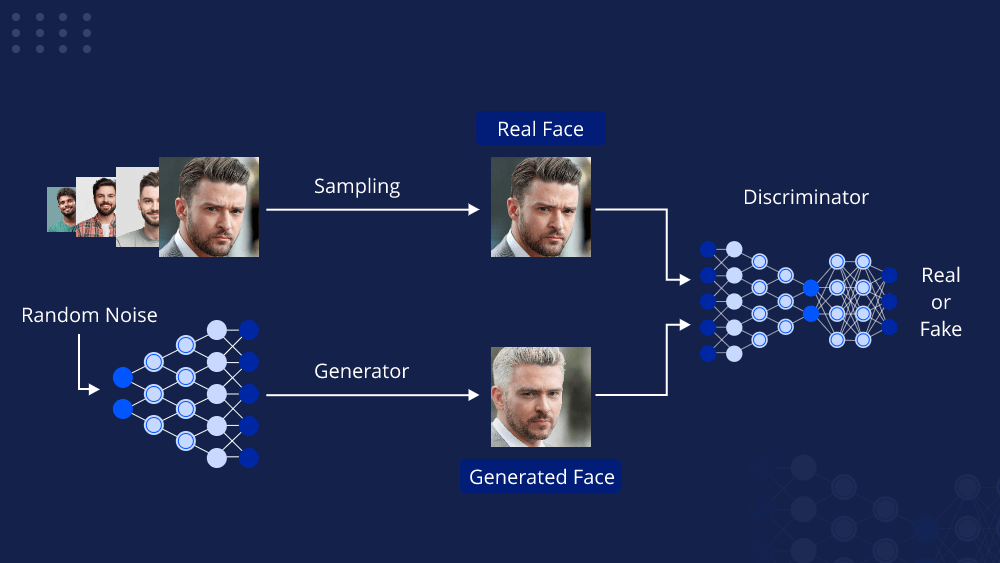
- Familiarize yourself with deep learning concepts, especially generative adversarial networks (GANs) and variational autoencoders (VAEs). These are the two primary architectures used for image synthesis.
- Gain knowledge of popular deep learning frameworks such as TensorFlow and PyTorch, which provide powerful tools for building and training generative AI models.
2. Collect and Preprocess Data:
- Acquire a dataset containing a large number of images relevant to your project. Datasets like ImageNet or COCO are commonly used for various image synthesis tasks.
- Clean and preprocess the dataset to remove any irrelevant or low-quality images. Normalize the images by resizing them to a consistent resolution and applying appropriate transformations if needed.
3. Choose the Right Architecture:
- Select the most suitable generative model architecture based on your project requirements. GANs and VAEs have different strengths and weaknesses, so evaluate which one aligns better with your goals.
- GANs are known for their ability to generate highly realistic images but may be challenging to train. VAEs offer more control over the generation process and tend to produce smoother and less diverse outputs.
4. Build and Train the Model:
- Implement the chosen architecture using your preferred deep learning framework. Define the generator and discriminator (for GANs) or encoder and decoder (for VAEs) components of the model.
- Design an appropriate loss function to guide the training process. For GANs, the objective is to optimize the generator to fool the discriminator, while VAEs typically use a reconstruction loss and a regularization term.
- Train the model using your preprocessed dataset. Monitor the training progress and adjust hyperparameters as necessary to improve the quality of generated images.
5. Enhance Model Performance:
- Experiment with advanced techniques to enhance the performance of your generative AI model. Consider incorporating architectural modifications such as progressive growing, attention mechanisms, or self-attention.
- Explore methods like conditional GANs or VAEs, which allow the generation of images based on specific attributes or input conditions, enabling more control over the output.
- Utilize transfer learning by starting with a pre-trained model and fine-tuning it on your specific dataset. This approach can accelerate training and improve results.
6. Evaluate and Fine-Tune:
- Assess the quality of generated images using appropriate evaluation metrics, such as Inception Score or Fréchet Inception Distance. These metrics measure the realism and diversity of the generated images.
- Fine-tune your model based on the evaluation results. Adjust hyperparameters, modify the architecture, or incorporate additional training techniques to improve the generated image quality further.
7. Deploy and Utilize:
- Once you’re satisfied with the performance of your generative AI model, deploy it in a production environment or integrate it into your desired application.
- Utilize the model to generate new images, explore design possibilities, or aid in creative endeavors. You can generate novel artwork, synthesize new realistic textures, or even assist in data augmentation for other computer vision tasks.
Building generative AI models for image synthesis requires a combination of theoretical knowledge, practical implementation skills, and iterative experimentation. As you dive into this exciting field, remember to stay curious, explore new ideas, and embrace the iterative nature of model development. With time and practice, you’ll be able to create stunning and realistic images using the power of generative AI.
To Learn More:- https://www.leewayhertz.com/a-guide-on-generative-ai-models-for-image-synthesis/
 Jasper's Business Blog