
Artificial Intelligence (AI) has rapidly become a transformative force in various industries, and healthcare is no exception. Among the various branches of AI, Generative AI stands out for its ability to create new data and generate content that mimics human creativity. By leveraging this technology, the healthcare sector has witnessed significant advancements, revolutionizing the way medical professionals diagnose, treat, and manage diseases. In this article, we explore ten ways Generative AI is transforming healthcare.
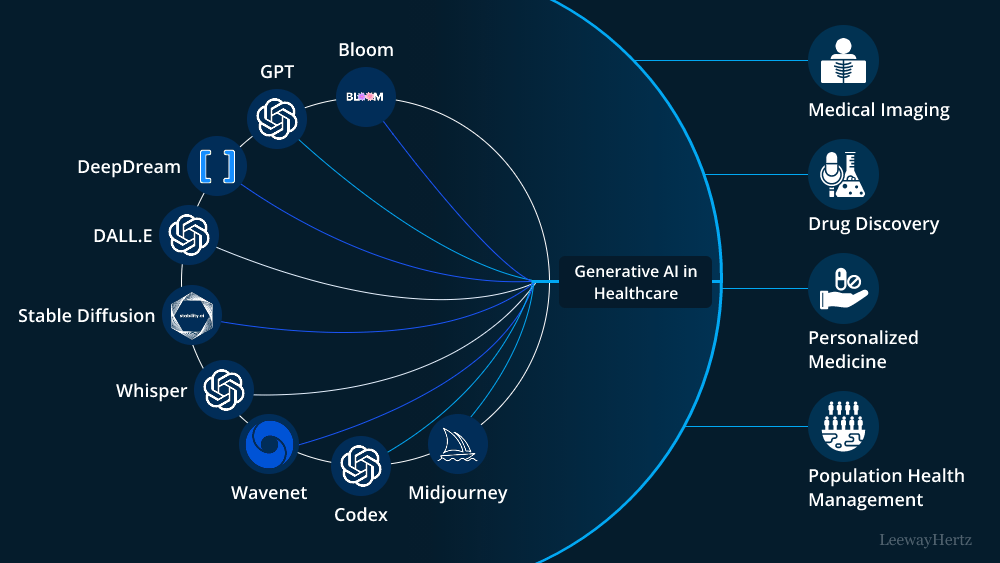
- Medical Imaging Enhancement:
Generative AI has shown immense potential in improving medical imaging. By processing large volumes of medical images, AI algorithms can enhance the quality of scans, making it easier for physicians to identify abnormalities and diagnose conditions more accurately. This aids in early detection, leading to timely interventions and better patient outcomes.
- Drug Discovery and Development:
Traditional drug discovery and development are time-consuming and expensive processes. Generative AI expedites this journey by simulating molecular structures and predicting their efficacy against specific diseases. Pharmaceutical companies can leverage AI-generated molecules to streamline drug testing, potentially leading to the discovery of novel and more effective treatments.
- Personalized Treatment Plans:
Healthcare is increasingly moving towards personalized medicine, and Generative AI plays a crucial role in tailoring treatment plans for individual patients. By analyzing vast patient data, AI algorithms can predict treatment responses, identify potential risks, and recommend personalized interventions, ensuring patients receive targeted therapies for better results.
- Disease Prediction and Prevention:
Early identification of diseases is crucial for effective treatment. Generative AI enables healthcare systems to analyze vast amounts of patient data, such as medical records, lifestyle choices, and genetic information, to identify patterns that precede certain diseases. This aids in proactive prevention measures and empowers individuals to take charge of their health.
- Virtual Medical Assistants:
Generative AI-powered virtual medical assistants are transforming patient-doctor interactions. These assistants can engage with patients, gather medical histories, provide basic medical advice, and even schedule appointments. They reduce administrative burdens on healthcare providers, allowing them to focus more on patient care.
- Natural Language Processing (NLP) in Healthcare:
NLP, a subset of Generative AI, is instrumental in deciphering unstructured medical data, such as clinical notes, research papers, and patient narratives. By extracting valuable insights from this data, NLP aids in research, decision-making, and clinical documentation, enhancing overall healthcare efficiency.
- Mental Health Support:
Mental health issues are on the rise, and Generative AI-powered mental health chatbots are proving to be valuable resources. These chatbots provide a confidential and accessible platform for individuals to express their thoughts and emotions, offering support, coping mechanisms, and even suggesting when professional intervention is necessary.
- Robotic Surgery:
Generative AI has significantly impacted the field of robotic surgery. Advanced surgical robots, equipped with AI algorithms, enable precise and minimally invasive procedures. The technology enhances a surgeon’s capabilities, reduces human errors, and promotes faster patient recovery.
- Patient Monitoring and Wearables:
Generative AI algorithms are integrated into wearables and remote monitoring devices, enabling real-time tracking of patient health. From monitoring vital signs to predicting health fluctuations, these devices aid healthcare professionals in providing proactive care and preventing medical emergencies.
- Medical Research and Innovation:
Generative AI expedites medical research by simulating experiments, generating hypotheses, and aiding data analysis. By automating these processes, researchers can save time and resources, leading to faster breakthroughs and advancements in medical science.
Conclusion:
Generative AI is ushering in a new era of possibilities in the healthcare industry. From enhancing medical imaging to powering robotic surgery and advancing drug discovery, this technology is transforming how we approach healthcare. By integrating Generative AI into various aspects of healthcare, we can expect to see more accurate diagnoses, personalized treatment plans, and improved patient outcomes. However, ethical considerations and data privacy must be diligently addressed to ensure the responsible and secure implementation of Generative AI in healthcare. As the field continues to evolve, the collaboration between AI and medical professionals promises a brighter and healthier future for humanity.
To Learn More:- https://www.leewayhertz.com/generative-ai-in-healthcare
 Jasper's Business Blog