
Generative Artificial Intelligence (AI) has revolutionized various industries, and healthcare is no exception. The ability of generative AI models to create, simulate, and generate data has opened up a plethora of use cases that enhance medical research, diagnosis, treatment, and patient care. This article highlights ten impactful use cases of generative AI in healthcare, showcasing how this technology is transforming the landscape of medicine.
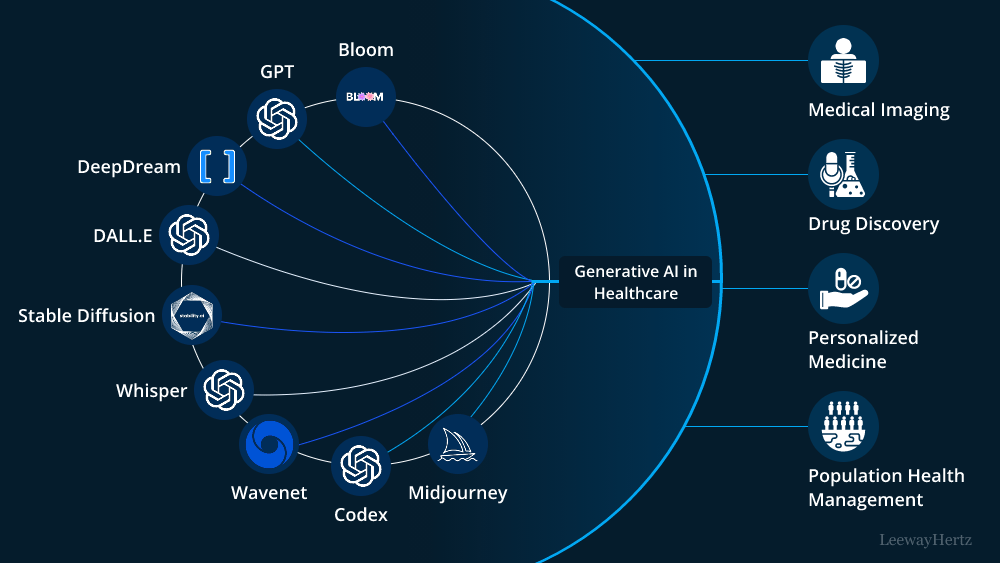
- Medical Image Generation and Augmentation
Generative AI has been instrumental in generating synthetic medical images, such as X-rays, CT scans, and MRI scans. These synthetic images can be used to augment limited datasets, facilitating more robust training of machine learning algorithms for medical image analysis. This approach is particularly useful in cases where acquiring large datasets is difficult or where patient privacy concerns arise.
- Drug Discovery and Development
Generative AI is streamlining drug discovery processes by generating novel molecular structures and predicting their properties. AI models can predict molecular interactions, identify potential drug candidates, and optimize molecular structures, leading to faster and more cost-effective drug development pipelines.
- Personalized Medicine
Generative AI is enabling personalized medicine by analyzing patient data to predict individual responses to treatments. By considering genetic, environmental, and lifestyle factors, AI models can recommend personalized treatment plans tailored to each patient’s unique characteristics, enhancing treatment efficacy and reducing adverse effects.
- Disease Diagnosis and Prognosis
AI-powered generative models are revolutionizing disease diagnosis by analyzing patient symptoms, medical history, and imaging data. These models can help physicians make more accurate and timely diagnoses, leading to better patient outcomes. Additionally, generative AI is used for disease prognosis, predicting disease progression and potential complications.
- Virtual Patient Simulations
Generative AI has paved the way for realistic virtual patient simulations. These simulations enable medical students and healthcare professionals to practice complex procedures in a risk-free environment, enhancing their skills and decision-making capabilities.
- Medical Text Generation
AI-generated medical text is used to automate medical report writing, create patient summaries, and assist in electronic health record (EHR) management. This application saves time for healthcare professionals, allowing them to focus more on patient care.
- Psychological Therapy and Mental Health Support
Generative AI is making a significant impact in mental health support by creating chatbots and virtual assistants capable of providing counseling and therapeutic support. These AI-powered assistants can offer 24/7 availability, personalized interactions, and anonymity, making mental health support more accessible to a larger population.
- Drug Dosage Optimization
AI models can analyze patient data and recommend optimized drug dosages based on individual responses and other relevant factors. This approach improves medication safety and effectiveness, reducing the risk of adverse reactions.
- Medical Data Imputation
Generative AI can impute missing data in medical datasets, improving the quality of the information used for analysis and research. This capability helps researchers draw more accurate conclusions and make better-informed decisions based on complete data.
- Healthcare System Optimization
AI-powered generative models can analyze healthcare system data, such as patient flow, resource utilization, and waiting times, to optimize hospital operations and resource allocation. This optimization leads to improved efficiency, reduced costs, and better patient experiences.
Conclusion
Generative AI is transforming healthcare in numerous ways, from generating medical images to revolutionizing drug discovery and personalized medicine. As technology advances and AI models become more sophisticated, the potential for generative AI in healthcare seems limitless. However, it is essential to address ethical, privacy, and regulatory considerations to ensure responsible and secure implementation. As researchers and healthcare professionals continue to collaborate, the future of generative AI in healthcare holds the promise of better patient outcomes, more efficient medical practices, and ultimately, an improved healthcare system for all.
To Learn More:- https://www.leewayhertz.com/generative-ai-in-healthcare/
 Jasper's Business Blog