
In the ever-evolving landscape of artificial intelligence (AI), breakthroughs continue to reshape the way we interact with technology and the world around us. One such remarkable advancement is the Action Transformer Model, a revolutionary neural network architecture that is pushing the boundaries of AI capabilities. This model has the potential to transform industries, from healthcare to autonomous vehicles, by enabling machines to not only understand and generate text but also take real-world actions. In this article, we will delve into the fascinating world of the Action Transformer Model, exploring its architecture, applications, and the profound impact it is poised to make.
Understanding the Transformer Architecture
Before we dive into the specifics of the Action Transformer Model, it’s crucial to understand its foundation—the Transformer architecture. The Transformer, introduced in a groundbreaking 2017 paper by Vaswani et al., marked a pivotal moment in natural language processing (NLP). It replaced the traditional recurrent and convolutional neural networks with a novel attention mechanism that allowed it to capture long-range dependencies in data efficiently. This architecture has since become the backbone for many state-of-the-art NLP models.
The Transformer’s core innovation is the self-attention mechanism, which allows it to weigh the importance of different parts of an input sequence when making predictions. This mechanism, combined with layers of stacked encoders and decoders, forms the building blocks of the Action Transformer Model.
Introducing the Action Transformer Model
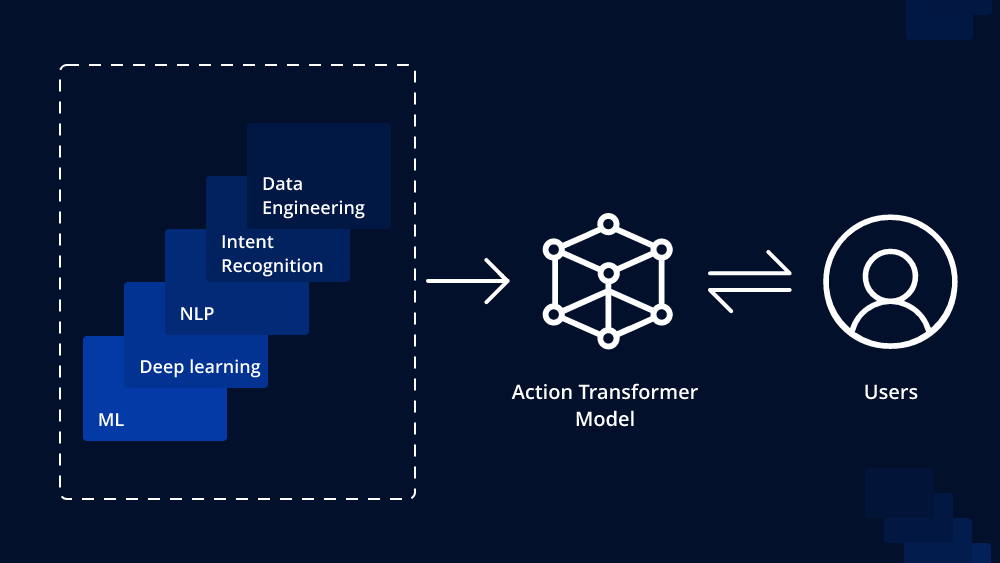
The Action Transformer Model is an extension of the Transformer architecture that goes beyond text understanding and generation. Developed by researchers and engineers passionate about bridging the gap between language understanding and real-world actions, this model is designed to connect language with physical environments. At its core, the Action Transformer Model fuses the power of NLP with the capability to perform actions in the real world.
The key innovation of the Action Transformer Model lies in its ability to take textual input, understand its meaning, and then perform corresponding actions. This breakthrough has the potential to revolutionize numerous industries and domains.
Applications of the Action Transformer Model
- Healthcare: In the healthcare sector, the Action Transformer Model can be employed to extract vital information from medical records and scientific literature, interpret patient symptoms, and recommend appropriate treatment plans. Moreover, it can interface with medical devices to provide real-time patient monitoring and alerts.
- Autonomous Vehicles: Self-driving cars are becoming increasingly prevalent, and the Action Transformer Model plays a vital role in enhancing their capabilities. It can process traffic signs, road conditions, and even communicate with pedestrians, making autonomous vehicles safer and more efficient.
- Robotics: In the realm of robotics, the Action Transformer Model enables robots to understand human commands and carry out complex tasks. This can range from household chores to manufacturing processes, significantly enhancing automation capabilities.
- Customer Service: Chatbots powered by the Action Transformer Model can provide more intuitive and helpful responses to customer queries. They can understand context, provide detailed information, and even execute actions such as booking reservations or placing orders.
- Education: The model can personalize education by understanding a student’s queries and tailoring learning materials accordingly. It can even assist in creating interactive educational content.
Challenges and Future Prospects
While the Action Transformer Model holds immense promise, it also faces several challenges. One of the primary concerns is ensuring the safe and ethical use of this technology. As AI systems gain the ability to take physical actions, it becomes crucial to establish robust safeguards and regulations.
Additionally, fine-tuning the model’s ability to understand nuanced and context-dependent language remains a significant area of research. Improvements in natural language understanding will directly translate into more effective real-world actions.
Looking ahead, the Action Transformer Model is expected to continue evolving. Researchers are exploring ways to enhance its multimodal capabilities, allowing it to understand not only text but also images, audio, and other sensory inputs. This will open up new avenues for applications across diverse domains.
Conclusion
The Action Transformer Model represents a monumental step forward in the field of artificial intelligence. Its ability to bridge the gap between language understanding and real-world actions has the potential to reshape industries and improve countless aspects of our daily lives. As researchers and engineers continue to refine this technology and address its challenges, we can look forward to a future where machines not only understand our words but also respond with meaningful and impactful actions, making the world a smarter and more efficient place.
 Jasper's Business Blog