Demystifying the Construction of GPT Models: Unveiling the Complexities

Building a GPT (Generative Pre-trained Transformer) model: a feat at the forefront of artificial intelligence and natural language processing. This intricate process combines cutting-edge technology, colossal datasets, and computational prowess to fashion a model capable of remarkable feats in understanding and generating human-like text.
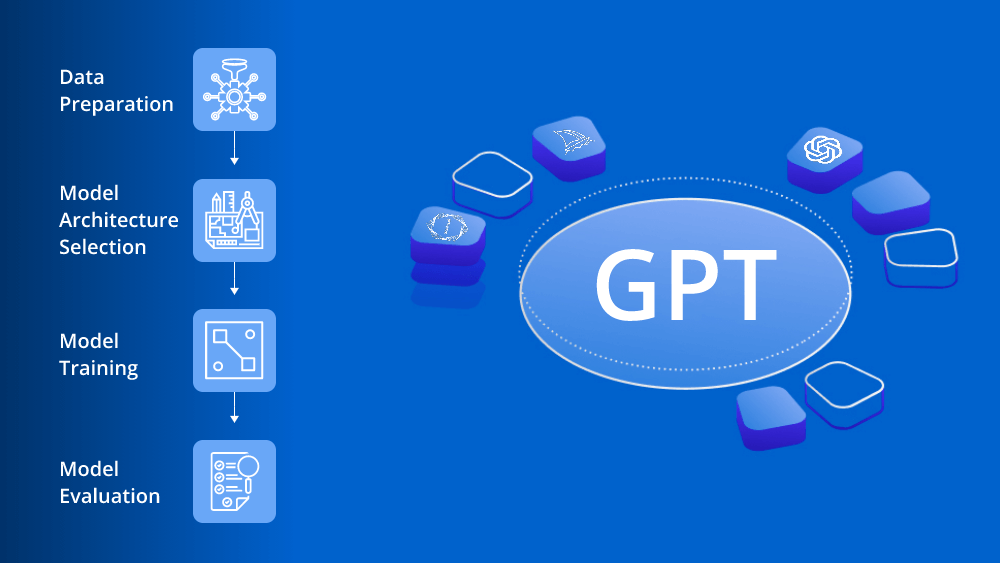
The Data Journey: From Collection to Preprocessing

At the heart of a GPT model lies a vast reservoir of text data drawn from an array of sources spanning books, articles, websites, and more. This data, collected in copious amounts, undergoes meticulous preprocessing. It’s cleaned, tokenized, and formatted, readying it for the model’s voracious appetite for learning.

Architecting Intelligence: Training the GPT Model

The architecture of a GPT model is meticulously crafted, determining the intricate web of layers, attention mechanisms, and parameters. Training this mammoth model demands an exorbitant amount of computational muscle—GPU and TPU clusters bear the weight of this Herculean task. Iteratively adjusting millions of parameters, the model learns the nuances of language, predicting the next word in a sequence with uncanny accuracy.

Refinement and Customization: Fine-Tuning and Optimization

Once the foundation is laid, fine-tuning beckons. This stage involves training the model on domain-specific or task-specific data, tailoring its capabilities for specialized use cases. An ongoing pursuit of optimization refines the model’s performance, striving for efficiency and excellence.

The Crucible of Evaluation: Assessing GPT’s Prowess

The model’s mettle is tested and measured through stringent evaluations. Metrics like perplexity gauge its ability to predict text fluently, while qualitative assessments discern the quality of generated text. The model is put through its paces on unseen data, ensuring its adaptability and reliability.

Deploying Power: From Development to Real-World Use

A triumphant model is primed for deployment in diverse applications. However, this is merely the beginning—continuous monitoring, updates, and enhancements are crucial to maintain its prowess amidst ever-evolving language patterns and user needs.

Navigating the Challenges: Pioneering the Future of GPT Models

Yet, the journey isn’t without obstacles. Enormous computational demands pose accessibility barriers, while ensuring data quality and mitigating biases remain ongoing challenges. Ethical considerations surrounding responsible use and potential misuse cast a critical eye on these AI marvels.

In Conclusion: GPT Models as Harbingers of AI Evolution

The construction of a GPT model orchestrates a symphony of technological prowess and data finesse. Despite its complexities, it stands as a testament to humanity’s strides in AI and natural language processing. As these models continue to evolve, they promise unparalleled advancements and applications across industries, reshaping the very fabric of human-AI interaction.
Standard

The Transformative Power of AI for Enterprises: Revolutionizing Operations and Innovation

In the era of rapid technological advancements, Artificial Intelligence (AI) stands out as a game-changer for enterprises across industries. From optimizing operations to revolutionizing customer experiences, AI for enterprises has become an indispensable tool driving efficiency, innovation, and competitiveness.

Driving Operational Efficiency

Enterprises face the constant challenge of maximizing efficiency while minimizing costs. AI has emerged as a solution by automating repetitive tasks, streamlining processes, and enabling predictive analytics.

For instance, in manufacturing, AI-powered predictive maintenance systems can anticipate equipment failures, reducing downtime and enhancing productivity. In logistics, AI algorithms optimize route planning, minimizing delivery times and fuel consumption. These implementations not only save costs but also improve overall operational effectiveness.

Enhancing Customer Experiences

In today’s customer-centric market, delivering exceptional experiences is key to success. AI empowers enterprises to understand and cater to individual customer needs at scale. Through data analysis and machine learning, AI predicts customer preferences, allowing for personalized recommendations and targeted marketing campaigns.

Chatbots and virtual assistants, fueled by AI, provide instantaneous and personalized support, enhancing customer satisfaction while reducing the burden on human resources. Natural Language Processing (NLP) enables sentiment analysis, allowing companies to gauge customer feedback and sentiments in real-time.

Facilitating Innovation and Decision-Making

AI facilitates innovation by augmenting human capabilities. Through advanced analytics and machine learning algorithms, enterprises gain deeper insights into market trends, enabling data-driven decision-making. AI-powered tools aid in product development, optimizing designs and functionalities based on user feedback and data analysis.

Moreover, AI fosters creativity by automating repetitive tasks, freeing up human resources to focus on more strategic and inventive initiatives. This synergy between AI and human creativity drives innovation, fostering a culture of continuous improvement within enterprises.

Challenges and Ethical Considerations

Despite its transformative potential, AI adoption in enterprises is not without challenges. Data privacy concerns, ethical considerations, and the need for responsible AI deployment remain paramount. Ensuring transparency, fairness, and accountability in AI algorithms is crucial to maintain trust among customers and stakeholders.

Additionally, there is a growing need for upskilling the workforce to leverage AI effectively. Enterprises must invest in training programs to enable employees to work collaboratively with AI systems, fostering a symbiotic relationship between human intelligence and AI capabilities.

Conclusion

Artificial Intelligence has become a cornerstone of enterprise transformation, revolutionizing operations, innovation, and customer experiences. Embracing AI not only enhances efficiency and productivity but also unlocks new realms of creativity and innovation.

As enterprises navigate the evolving landscape, responsible AI adoption coupled with continuous upskilling will be imperative. The synergy between human expertise and AI capabilities will shape a future where enterprises thrive in a data-driven, innovative ecosystem.

In essence, AI isn’t just a technological advancement; it’s a catalyst for the evolution of enterprises, enabling them to adapt, innovate, and thrive in an ever-changing business landscape.

Standard

The Evolution of Programming: AI-Assisted Coding

In the ever-evolving landscape of technology, the role of Artificial Intelligence (AI) has transcended its traditional boundaries, reaching into the very heart of programming itself. AI-assisted coding, an innovation poised to revolutionize the way developers write, understand, and optimize code, stands as a testament to the transformative power of AI in the realm of software development.

  • AI-assisted coding involves the use of machine learning algorithms, natural language processing, and predictive analytics to assist programmers in various stages of the development process.
  • This technology is designed to enhance efficiency, accuracy, and overall productivity in software development tasks, empowering both seasoned developers and novices alike.
  • One of the most significant advantages of AI-assisted coding is its ability to augment human capabilities. These AI tools can analyze vast repositories of code, identifying patterns, suggesting optimizations, and even generating code snippets to expedite development.
  • By leveraging historical data and best practices, these systems help programmers make informed decisions and write higher quality code.
  • One of the key applications of AI in coding is code completion. AI-powered autocomplete tools, integrated into popular Integrated Development Environments (IDEs), offer predictive suggestions as developers type, reducing keystrokes and potential errors.

These tools, trained on extensive codebases, learn from context and provide tailored recommendations, significantly speeding up the coding process.

Additionally, AI-assisted debugging has emerged as a valuable asset for developers. By analyzing runtime behavior and error patterns, AI can pinpoint potential bugs, suggesting solutions or highlighting problematic code sections. This proactive approach to debugging streamlines the troubleshooting process, leading to more robust and reliable software.

Moreover, AI-driven code reviews have become instrumental in ensuring code quality and adherence to best practices. These systems analyze code against established guidelines, identifying potential vulnerabilities, performance issues, or compliance concerns. By automating this process, developers receive timely feedback, enabling them to rectify issues early in the development cycle.

Furthermore, AI is making strides in enabling natural language interfaces for programming. Through conversational AI interfaces, developers can interact with code in a more intuitive manner, expressing their intent in plain language and receiving suggestions or code transformations in response. This bridges the gap for individuals with varying levels of programming expertise, democratizing access to software development.

However, while AI-assisted coding brings numerous benefits, it is not without challenges. Concerns about biases in training data, over-reliance on AI suggestions, and the need for continuous learning and adaptation persist. Developers must exercise caution and critical thinking when incorporating AI-generated code or suggestions into their projects, ensuring the integrity and security of their software.

Conclusion

AI-assisted coding represents a paradigm shift in software development, empowering developers with tools to enhance productivity, code quality, and collaboration. As AI continues to evolve, its integration into the coding workflow will likely become more seamless and indispensable, ushering in an era of innovation and efficiency in programming. Embracing this technology while being mindful of its limitations will pave the way for a future where humans and machines collaborate harmoniously to create exceptional software solutions.

Standard