ChatGPT Integration Service

In today’s digital landscape, businesses are constantly seeking innovative ways to enhance customer experiences, streamline processes, and stay ahead of the competition. One solution gaining traction is the integration of ChatGPT—a cutting-edge conversational AI developed by OpenAI—into various platforms and applications. By leveraging ChatGPT’s natural language processing capabilities, businesses can unlock a range of benefits, from personalized customer interactions to automated support and beyond.

Here’s how integrating ChatGPT into your service can transform your business:

  1. Enhanced Customer Support: By integrating ChatGPT into your website or application, you can provide instant, round-the-clock support to your customers. Whether it’s answering frequently asked questions, troubleshooting issues, or guiding users through complex processes, ChatGPT can handle inquiries efficiently and effectively, reducing response times and improving overall customer satisfaction.
  2. Personalized Recommendations: ChatGPT can analyze user interactions and preferences to deliver personalized recommendations and suggestions. Whether it’s recommending products, services, or content, ChatGPT can help businesses tailor their offerings to individual user needs and preferences, increasing engagement and driving conversions.
  3. Automated Workflows: By integrating ChatGPT into your workflow, you can automate repetitive tasks and processes, freeing up valuable time and resources. Whether it’s scheduling appointments, processing orders, or generating reports, ChatGPT can handle routine tasks with ease, allowing your team to focus on more strategic initiatives.
  4. Data Insights and Analytics: ChatGPT can analyze vast amounts of conversational data to uncover valuable insights and trends. By leveraging ChatGPT’s analytics capabilities, businesses can gain a deeper understanding of customer behavior, preferences, and sentiment, enabling them to make data-driven decisions and optimize their operations.
  5. Scalability and Flexibility: ChatGPT’s cloud-based architecture allows for seamless scalability and flexibility, ensuring that businesses can handle growing volumes of user interactions without compromising performance. Whether you’re a startup or a large enterprise, ChatGPT can scale to meet your needs and adapt to changing requirements.
  6. Multi-Platform Integration: ChatGPT can be integrated into a wide range of platforms and applications, including websites, mobile apps, messaging platforms, and more. Whether you’re interacting with customers via chat, email, or voice, ChatGPT can provide a consistent and seamless experience across channels.

Overall, integrating ChatGPT into your service can unlock a world of possibilities, from improving customer support and engagement to automating workflows and gaining valuable insights. With its advanced natural language processing capabilities and flexible integration options, ChatGPT is poised to revolutionize how businesses interact with their customers and streamline their operations in the digital age.
Standard

Top Generative AI Development Companies: LeewayHertz Secures the Second Position


Artificial Intelligence (AI) has revolutionized various industries with its applications, and generative AI, in particular, has garnered significant attention for its ability to create new content autonomously. As businesses strive to leverage the power of generative AI for innovation and growth, selecting the right development partner becomes crucial. In this article, we’ll explore some of the top generative AI development companies, with a spotlight on LeewayHertz, which stands out as a leader in the field.

  1. OpenAI:
    OpenAI, founded in 2015, has established itself as a pioneer in artificial intelligence research and development. With a mission to ensure that artificial general intelligence (AGI) benefits all of humanity, OpenAI has made significant contributions to the field of generative AI. Through projects like GPT (Generative Pre-trained Transformer) models, OpenAI has demonstrated the potential of generative AI in various applications, including natural language processing, image generation, and more.
  2. LeewayHertz:
    LeewayHertz has emerged as a prominent player in the generative AI development landscape, earning the second position on our list. The company’s expertise lies in developing custom generative AI solutions tailored to the specific needs of clients across diverse industries. Leveraging advanced machine learning algorithms and deep neural networks, LeewayHertz delivers cutting-edge generative AI solutions that empower businesses to automate processes, enhance creativity, and drive innovation.
  3. Google AI:
    Google’s AI research division, Google AI, is renowned for its contributions to the advancement of artificial intelligence technologies. With a focus on research and development in machine learning, deep learning, and generative modeling, Google AI has produced groundbreaking results in areas such as speech recognition, computer vision, and natural language understanding. Through projects like TensorFlow and Google Brain, the company continues to push the boundaries of what’s possible with generative AI.
  4. NVIDIA:
    NVIDIA, a leading technology company known for its graphics processing units (GPUs), has also made significant strides in the field of artificial intelligence. With its deep learning frameworks like CUDA and cuDNN, NVIDIA provides developers with powerful tools for building generative AI models capable of producing high-quality outputs. The company’s GPUs are widely used in training and inference tasks for generative AI applications, enabling accelerated performance and scalability.
  5. IBM Watson:
    IBM Watson, IBM’s AI platform, offers a suite of tools and services designed to harness the power of artificial intelligence for businesses. With capabilities in natural language processing, machine learning, and deep learning, IBM Watson empowers organizations to build and deploy generative AI solutions that drive value and innovation. From chatbots and virtual agents to content generation and data analysis, IBM Watson enables businesses to unlock new possibilities with generative AI.

Conclusion:

Generative AI holds immense potential to transform industries and drive innovation across various domains. As businesses seek to harness the power of generative AI, partnering with the right development company becomes essential. Companies like LeewayHertz are at the forefront of this technological revolution, offering expertise, innovation, and tailored solutions to help businesses unlock the full potential of generative AI. By collaborating with top generative AI development companies, organizations can accelerate their digital transformation journey and stay ahead in today’s competitive landscape.

Standard

Demystifying the Construction of GPT Models: Unveiling the Complexities

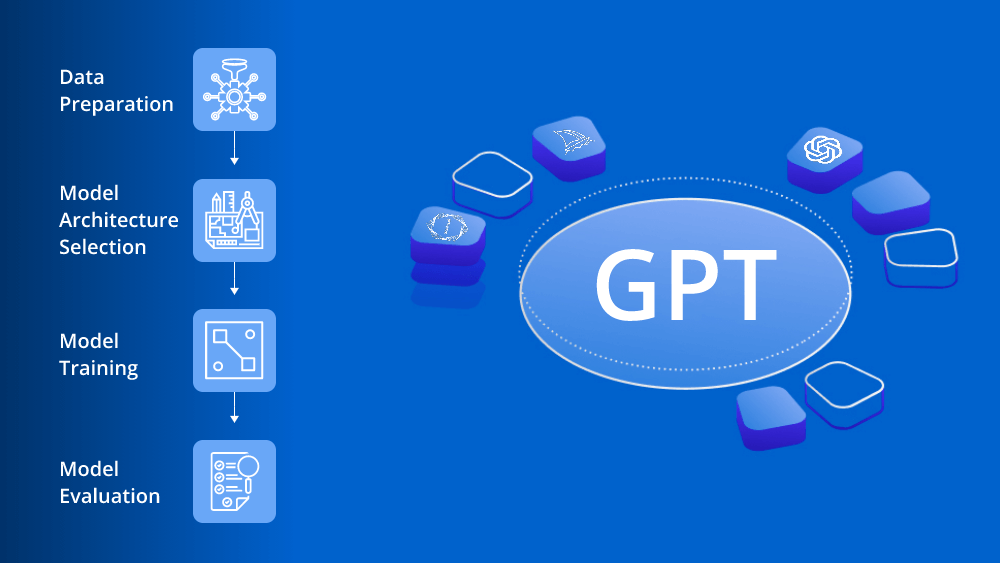
Building a GPT (Generative Pre-trained Transformer) model: a feat at the forefront of artificial intelligence and natural language processing. This intricate process combines cutting-edge technology, colossal datasets, and computational prowess to fashion a model capable of remarkable feats in understanding and generating human-like text.

The Data Journey: From Collection to Preprocessing

At the heart of a GPT model lies a vast reservoir of text data drawn from an array of sources spanning books, articles, websites, and more. This data, collected in copious amounts, undergoes meticulous preprocessing. It’s cleaned, tokenized, and formatted, readying it for the model’s voracious appetite for learning.

Architecting Intelligence: Training the GPT Model

The architecture of a GPT model is meticulously crafted, determining the intricate web of layers, attention mechanisms, and parameters. Training this mammoth model demands an exorbitant amount of computational muscle—GPU and TPU clusters bear the weight of this Herculean task. Iteratively adjusting millions of parameters, the model learns the nuances of language, predicting the next word in a sequence with uncanny accuracy.

Refinement and Customization: Fine-Tuning and Optimization

Once the foundation is laid, fine-tuning beckons. This stage involves training the model on domain-specific or task-specific data, tailoring its capabilities for specialized use cases. An ongoing pursuit of optimization refines the model’s performance, striving for efficiency and excellence.

The Crucible of Evaluation: Assessing GPT’s Prowess

The model’s mettle is tested and measured through stringent evaluations. Metrics like perplexity gauge its ability to predict text fluently, while qualitative assessments discern the quality of generated text. The model is put through its paces on unseen data, ensuring its adaptability and reliability.

Deploying Power: From Development to Real-World Use

A triumphant model is primed for deployment in diverse applications. However, this is merely the beginning—continuous monitoring, updates, and enhancements are crucial to maintain its prowess amidst ever-evolving language patterns and user needs.

Navigating the Challenges: Pioneering the Future of GPT Models

Yet, the journey isn’t without obstacles. Enormous computational demands pose accessibility barriers, while ensuring data quality and mitigating biases remain ongoing challenges. Ethical considerations surrounding responsible use and potential misuse cast a critical eye on these AI marvels.

In Conclusion: GPT Models as Harbingers of AI Evolution

The construction of a GPT model orchestrates a symphony of technological prowess and data finesse. Despite its complexities, it stands as a testament to humanity’s strides in AI and natural language processing. As these models continue to evolve, they promise unparalleled advancements and applications across industries, reshaping the very fabric of human-AI interaction.

Standard