Building Credit Risk Models Using Machine Learning

In today’s data-driven world, financial institutions are increasingly turning to machine learning techniques to build robust credit risk models. These models help lenders assess the likelihood of a borrower defaulting on a loan, enabling them to make informed decisions about lending and manage risk effectively. In this article, we’ll explore the process of building credit risk models using machine learning, from data collection and preprocessing to model selection and evaluation.

1. Understanding Credit Risk

Credit risk refers to the potential loss that a lender may incur if a borrower fails to repay a loan. It is a critical factor for financial institutions when determining whether to approve a loan application. Traditionally, credit risk assessment relied on statistical models based on historical data and predetermined rules. However, with the advent of big data and advances in machine learning, lenders can now leverage sophisticated algorithms to analyze large volumes of data and make more accurate predictions.

2. Data Collection and Preprocessing

The first step in building a credit risk model is collecting relevant data. This typically includes information such as credit history, income, employment status, debt-to-income ratio, and other demographic factors. Data can be sourced from internal sources such as loan applications and transaction records, as well as external sources like credit bureaus and public records.

Once the data is collected, it needs to be preprocessed to ensure quality and consistency. This involves tasks such as cleaning the data to remove errors and outliers, handling missing values, and encoding categorical variables. Additionally, feature engineering techniques may be applied to create new features that capture meaningful information from the data.

3. Model Selection and Training

With preprocessed data in hand, the next step is to select an appropriate machine learning algorithm for building the credit risk model. Common algorithms used for this purpose include logistic regression, decision trees, random forests, gradient boosting machines, and neural networks. The choice of algorithm depends on factors such as the complexity of the data and the interpretability of the model.

Once the algorithm is selected, the model is trained on a labeled dataset, where each data point is associated with a binary outcome indicating whether the borrower defaulted or not. During training, the model learns to identify patterns and relationships in the data that are predictive of credit risk.

4. Model Evaluation and Validation

After training the model, it is essential to evaluate its performance using validation techniques such as cross-validation and holdout validation. This involves splitting the dataset into training and testing sets, training the model on the training set, and then evaluating its performance on the testing set. Common evaluation metrics for credit risk models include accuracy, precision, recall, F1-score, and the receiver operating characteristic (ROC) curve.

It is crucial to assess the model’s performance not only in terms of overall accuracy but also its ability to correctly identify defaulters and non-defaulters. A model that achieves high accuracy but performs poorly on predicting defaults may not be suitable for practical use.

5. Model Deployment and Monitoring

Once the credit risk model is trained and validated, it can be deployed into production to assist lenders in making credit decisions. However, the deployment process does not end here. It is essential to monitor the model’s performance over time and periodically retrain it with updated data to ensure its accuracy and relevance.

Additionally, ongoing monitoring helps detect any drift or changes in the underlying data distribution, which may affect the model’s performance. If significant changes are observed, the model may need to be recalibrated or retrained to maintain its effectiveness.

Conclusion

Building credit risk models using machine learning is a complex but rewarding endeavor for financial institutions looking to improve their lending practices. By leveraging advanced algorithms and big data analytics, lenders can gain deeper insights into borrower behavior and make more informed credit decisions. However, it is essential to approach model development with caution, ensuring data quality, model interpretability, and ongoing monitoring to mitigate potential risks and maximize the model’s utility.
Standard

Understanding the Essence of Data Integration: A Comprehensive Overview

In today’s data-driven world, the abundance of information generated from disparate sources has become both a boon and a challenge for organizations. Amidst this wealth of data, the need to extract meaningful insights and drive informed decision-making has led to the emergence of data integration as a critical process. This comprehensive guide aims to unravel the essence of data integration, exploring its significance, methodologies, and the transformative impact it has on businesses.

Defining Data Integration

Data integration refers to the process of combining, transforming, and harmonizing data from various sources into a unified and coherent view. It involves merging data from disparate systems, databases, applications, or sources—irrespective of their format, structure, or location—into a single, cohesive dataset that can be analyzed, interpreted, and utilized effectively.

The Significance of Data Integration

  1. Holistic View of Information: Integrating data from diverse sources provides a comprehensive and holistic view of an organization’s operations, customers, and processes, enabling better insights and informed decision-making.
  2. Enhanced Data Accuracy and Consistency: By consolidating data, discrepancies and redundancies are minimized, leading to improved accuracy, consistency, and reliability of information.
  3. Improved Business Intelligence and Analytics: Integrated data serves as a foundation for robust business intelligence (BI) and analytics, enabling organizations to derive actionable insights and make data-driven decisions.
  4. Streamlined Operations and Efficiency: Access to integrated data streamlines processes, enhances collaboration, and boosts operational efficiency by providing a unified view across departments.
  5. Facilitating Innovation and Agility: Integrated data fosters innovation by empowering organizations to respond quickly to changing market trends, customer demands, and emerging opportunities.

Methodologies and Approaches to Data Integration

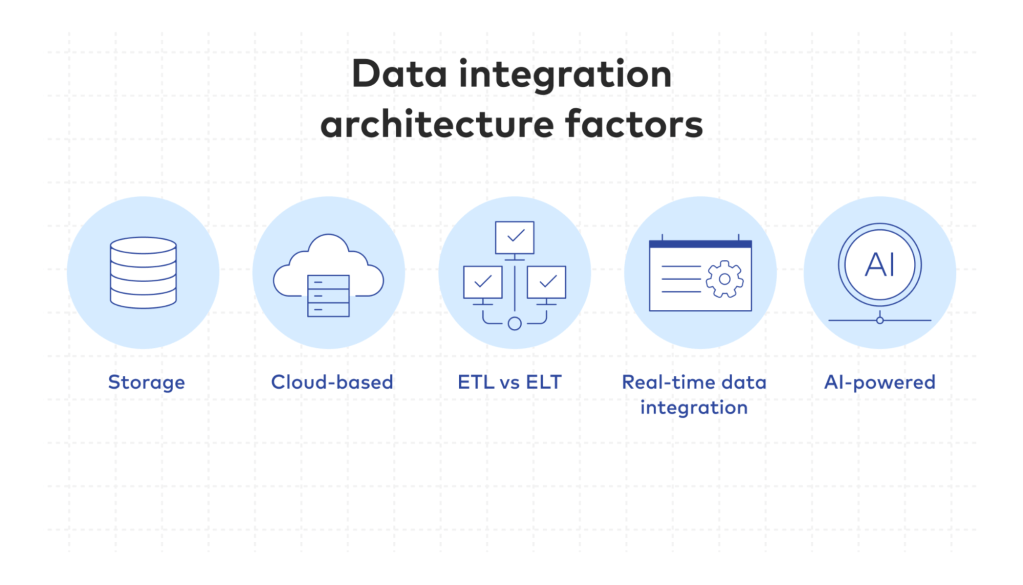
  1. ETL (Extract, Transform, Load): This approach involves extracting data from multiple sources, transforming it into a standardized format, and loading it into a target system or data warehouse.
  2. ELT (Extract, Load, Transform): In ELT, data is extracted and loaded into a target system first, and transformation occurs within the destination system or data warehouse. This approach is often used for big data processing.
  3. Data Virtualization: This technique creates a virtualized view of data from disparate sources without physically moving or replicating it. It enables real-time access to data and minimizes data duplication.
  4. API Integration: Application Programming Interfaces (APIs) facilitate direct connections between systems, allowing data to be exchanged and integrated in real time.

Challenges and Considerations in Data Integration

  1. Data Quality and Consistency: Maintaining data quality and consistency across diverse sources remains a challenge, requiring data cleansing and standardization processes.
  2. Data Security and Privacy: Integrating sensitive data raises concerns regarding security, compliance with regulations, and ensuring data privacy throughout the integration process.
  3. Complexity and Scalability: As data volumes and sources increase, managing the complexity of integration and ensuring scalability becomes a crucial consideration.
  4. Technological Heterogeneity: Dealing with different data formats, structures, and systems requires compatibility and interoperability between diverse technologies.

Impact of Data Integration on Businesses

  1. Improved Decision-Making: Access to integrated data empowers businesses to make informed decisions swiftly, based on accurate, real-time insights.
  2. Enhanced Customer Experience: A unified view of customer data allows for personalized and seamless experiences across various touchpoints.
  3. Operational Efficiency and Cost Savings: Streamlined processes and access to consolidated data contribute to operational efficiency and cost savings by eliminating redundancies and inefficiencies.
  4. Innovation and Competitive Edge: Harnessing integrated data fuels innovation, enabling businesses to stay agile, adapt to market changes, and maintain a competitive edge.

Conclusion

Data integration stands as a cornerstone in today’s data-centric landscape, bridging the gap between disparate data sources and unlocking the full potential of information. The ability to seamlessly merge, transform, and utilize data from various sources is pivotal in empowering organizations to thrive in a rapidly evolving business environment.

As businesses continue to recognize the transformative power of integrated data, the strategic implementation of robust data integration processes becomes imperative. Leveraging advanced methodologies, technologies, and a meticulous approach to handling challenges can empower organizations to harness the true value of their data, driving growth, innovation, and success in the digital age.

Standard